Hydration has become one of the most visible categories in the supplement industry. What used to be positioned mainly around sports performance has expanded into daily wellness, travel, heat exposure, active lifestyles, recovery, and general mineral replenishment.
The shift is easy to understand. Consumers are paying closer attention to how they feel throughout the day. Energy, focus, muscle function, recovery, and routine wellness are all tied to the broader conversation around hydration. As a result, hydration products are no longer limited to bottled sports drinks or flavored powders.
Capsules are becoming a serious format for hydration supplement brands because they solve a different consumer problem: convenience.
A hydration capsule does not need to be mixed. It does not require flavor masking. It does not add sugar. It can be taken before travel, after a workout, during a long workday, or as part of a daily supplement stack. For brands, capsules also create room for more targeted electrolyte and mineral formulas that fit specific use cases.
But hydration capsule manufacturing is not just a matter of putting minerals into a shell. Electrolyte ingredients can be dense, hygroscopic, mineral-heavy, and formulation-sensitive. To create a capsule that performs well, brands need the right manufacturing partner from the beginning.
Hydration supplements are moving beyond powders
The electrolyte powder market continues to grow, with Grand View Research estimating the global electrolyte powder market at $8.74 billion in 2024 and projecting steady growth through 2030. Future Market Insights also projects strong growth across the broader hydration supplement category, reflecting sustained demand for convenient hydration support.
Powders will remain important. They are useful when consumers want a flavored drink, larger serving sizes, or a beverage-based hydration ritual. But capsules give brands a different lane.
Hydration capsules are especially compelling for consumers who want:
- A portable option that fits into a bag, desk, gym kit, or travel case
- A sugar-free format
- No flavor, sweetener, or aftertaste
- A precise serving size
- A formula that pairs easily with other supplements
- A cleaner alternative to ready-to-drink products or heavily flavored powders
The opportunity is not to replace powders. The opportunity is to serve moments when powders are inconvenient.
That distinction matters. Strong brands do not force one format to do everything. They build the right format for the right behavior.
What goes into a hydration capsule?
Most hydration capsules are built around electrolytes and minerals that help support fluid balance and normal cellular function. Common ingredients may include sodium, potassium, magnesium, calcium, and chloride, depending on the formula and intended use.
Some brands may also include complementary ingredients such as trace minerals, vitamin C, B vitamins, coconut water powder, taurine, or other wellness-support ingredients. The right formula depends on the brand’s positioning, serving size, dietary preferences, and claims strategy.
For example, a hydration capsule for endurance athletes may look different from a daily hydration capsule for travelers or a wellness-focused mineral support product. The athlete-focused formula may prioritize sodium replacement and sweat loss support. The daily wellness version may use a more moderate electrolyte profile with magnesium or trace minerals.
The formulation strategy should begin with one question: what situation is this product meant to support?
Hydration is not one single consumer need. It can mean post-workout replenishment, heat support, travel support, morning routine, wellness stacking, recovery, or active lifestyle maintenance. The sharper the use case, the stronger the product.
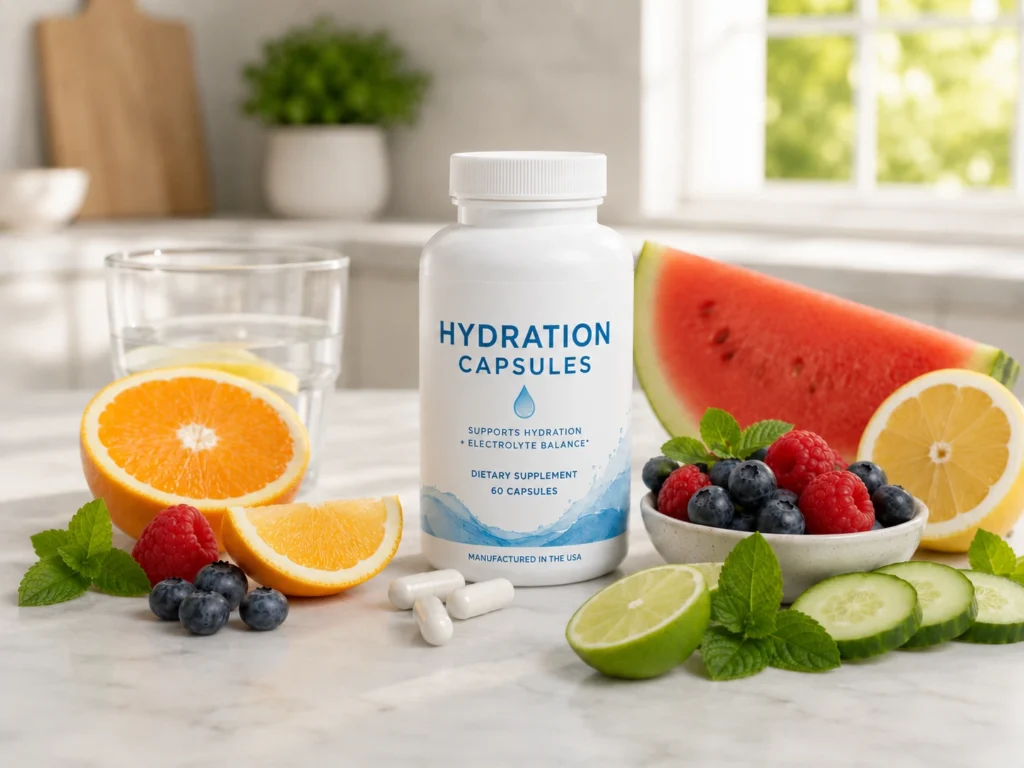
Capsule format matters
The capsule shell is not just packaging. It affects the final product’s positioning, consumer appeal, and manufacturing performance.
Hydration supplement brands may consider several capsule options, including gelatin capsules, vegetarian capsules, and other specialty formats depending on ingredient compatibility and brand requirements. Vegetarian capsules are often attractive for brands that want a plant-based or lifestyle-forward positioning. Gelatin capsules may be appropriate for other formulas depending on the desired performance and cost profile.
Capsule size is also a strategic decision. Electrolytes and minerals can require meaningful dosage space, which means brands need to balance potency with swallowability. A formula may look strong on paper but become less practical if the consumer needs to take too many capsules per serving.
This is where manufacturing guidance becomes important. A good capsule manufacturer can help evaluate ingredient density, flow, fill weight, capsule size, serving structure, and finished product feasibility before a brand gets too far into development.
Hydration capsules require careful formulation
Mineral ingredients can create real manufacturing challenges. Some electrolyte ingredients absorb moisture. Some have poor flow characteristics. Some can affect blend uniformity. Others may require specific handling to support consistency from batch to batch.
For hydration capsule manufacturing, key formulation considerations include:
Ingredient compatibility
Electrolytes, minerals, vitamins, and botanical ingredients need to work together within the same blend. The formula should be reviewed for stability, flow, potency, and finished product quality.
Moisture management
Some hydration ingredients can be sensitive to humidity. This can affect blending, encapsulation, storage, and finished capsule appearance. Moisture-conscious handling and packaging recommendations are important.
Dosage feasibility
A hydration capsule must fit the desired amount of active ingredients into a realistic serving size. This is one of the biggest differences between capsules and powders. Powders can carry larger electrolyte loads. Capsules must be more precise.
Blend uniformity
Mineral-heavy formulas require careful blending so that each capsule delivers the intended ingredient profile. Manufacturing controls matter, especially when working with small amounts of certain nutrients alongside larger mineral inputs.
Packaging selection
Hydration capsules may benefit from packaging that helps protect the formula from moisture and environmental exposure. Bottle choice, desiccants, closure systems, and shelf-life considerations should be part of the development process.
Capsules are not right for every hydration product
This is worth saying clearly: capsules are not always the best format for hydration.
If a brand wants to deliver a very high sodium formula, a large electrolyte dose, or a beverage experience, powder may be the stronger option. If the consumer expects to drink the product during exercise, a stick pack or tub may make more sense.
Capsules are strongest when the product is designed for convenience, portability, daily routine, and precise supplementation.
That makes hydration capsules especially interesting for brands building around specific lifestyle moments, such as:
- Travel hydration
- Sauna or heat exposure routines
- Daily mineral support
- Post-workout convenience
- Low-sugar wellness products
- Outdoor and endurance-adjacent lifestyles
- Workplace wellness
- Morning hydration routines
- Supplement stacks that pair hydration with energy, recovery, or wellness support
The best products do not chase format trends blindly. They match the format to the customer’s real behavior.
What to look for in a hydration capsule manufacturer
Hydration capsule manufacturing requires more than encapsulation capacity. Brands need a partner that understands formulation, sourcing, production, quality systems, and scale.
A strong manufacturing partner should be able to support:
- Formula development and review
- Ingredient sourcing guidance
- Capsule format selection
- Pilot and production planning
- Blending and encapsulation
- Quality control processes
- Packaging guidance
- Scalable production for growing brands
Dietary supplement manufacturing also requires strong quality systems. In the United States, dietary supplement manufacturers are subject to Current Good Manufacturing Practice requirements under 21 CFR Part 111. These requirements cover manufacturing, packaging, labeling, holding, specifications, records, and quality control processes.
For brands, this matters because hydration products sit at the intersection of consumer wellness, mineral dosing, and repeat-use routines. Quality cannot be treated as a back-end detail. It has to be built into the product from the beginning.
Why brands choose Somafina for capsule manufacturing
Somafina works with supplement brands that need reliable capsule manufacturing at scale. As one of the largest capsule manufacturers in North America, Somafina supports brands through the full product development and manufacturing process, from concept through finished product.
For hydration capsule brands, that means practical support across formulation feasibility, capsule selection, ingredient handling, production, and packaging considerations.
Whether the goal is a daily electrolyte capsule, a travel hydration product, a sports nutrition formula, or a broader wellness capsule, Somafina helps brands move from idea to market with the manufacturing infrastructure needed to grow.
The hydration category is becoming more sophisticated
Consumers are not just buying hydration. They are buying a use case.
They want products that fit into how they live. Some want a powder after training. Some want a drink mix during travel. Some want a capsule that sits next to their magnesium, multivitamin, or daily wellness stack.
That creates an important opportunity for supplement brands. Hydration does not have to be one product in one format. It can become a platform.
Capsules give brands a way to build more precise, convenient, and lifestyle-friendly hydration products. But the format only works when the product is formulated and manufactured with discipline.
The brands that win in hydration will not be the ones that simply add electrolytes to a label. They will be the ones that understand the consumer moment, build the right formula for that moment, and choose a manufacturing partner that can support quality at scale.
Ready to develop a hydration capsule?
Somafina helps supplement brands manufacture capsules built for today’s hydration market. From formulation support to capsule manufacturing and packaging guidance, our team can help you bring a hydration supplement to market with clarity and confidence.
Contact Somafina to learn more about hydration capsule manufacturing.