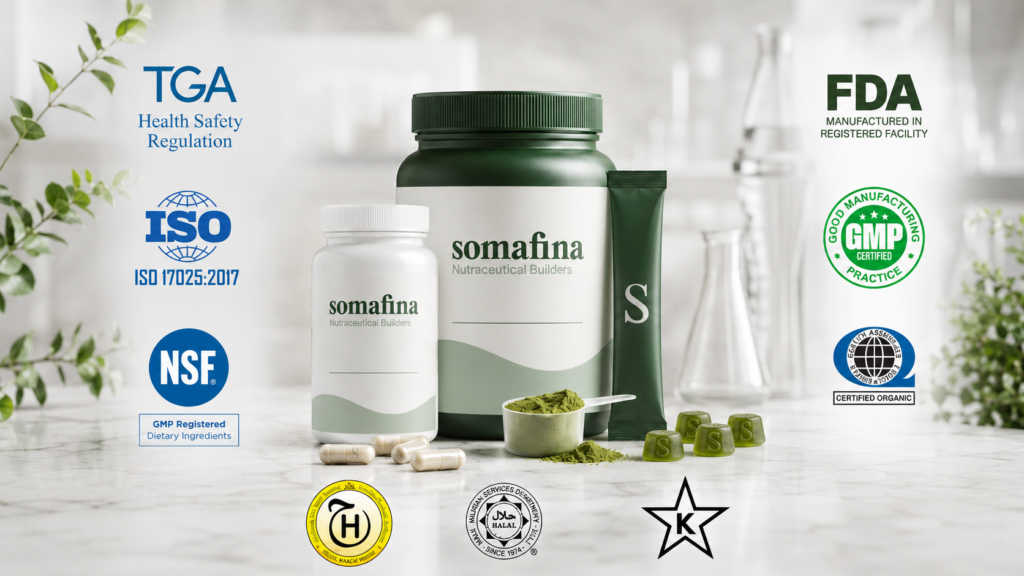
For supplement brands, choosing a manufacturer is not simply a production decision. It is a decision about product quality, operational risk, retailer readiness and the ability to scale.
A manufacturer may have the equipment and capacity to produce a formula, but capacity alone does not create a dependable supply chain. Growing brands also need repeatable processes, qualified laboratory testing, accurate documentation and quality systems that can withstand scrutiny from retailers, marketplaces, distributors and regulatory authorities.
The right manufacturing certifications can support those requirements.
Certifications do not automatically increase sales, and adding more logos to a label is not a growth strategy by itself. Their value comes from what they help a brand accomplish. A relevant certification may support retailer qualification, strengthen consumer confidence, make a product eligible for a specific dietary designation or remove a barrier to reaching a defined group of U.S. consumers.
At Somafina, we combine certified manufacturing, advanced production capabilities and rigorous supplement testing and quality control to help supplement brands build products that are ready for growth.
Certifications should support a brand’s commercial strategy
Consumers may notice certification marks on a bottle or package, but much of their value begins before the finished product reaches the shelf.
Certifications can influence:
- How raw materials are sourced and qualified
- Which ingredients can be used
- How equipment and production areas are cleaned
- How manufacturing procedures are documented
- Which analytical tests are performed
- Which dietary designations a product may carry
- Which retailers or marketplaces may accept the product
For a supplement brand, the important question is not how many certifications a manufacturer displays. It is whether those certifications support the formula, intended customer and route to market.
A certified organic capability may matter to a brand developing a plant-based wellness line. Halal or kosher certification may be important to a company seeking to reach consumers with specific dietary requirements. NSF GMP registration may carry particular weight during retailer, marketplace or supplier due diligence.
The right credential supports a specific commercial objective.
A qualified manufacturer can remove barriers to growth
Manufacturing requirements usually become more complex as a supplement brand expands.
A direct-to-consumer startup may initially focus on product development, packaging and customer acquisition. As the brand grows, it may need to:
- Complete retailer quality questionnaires
- Provide facility and certification records
- Submit certificates of analysis
- Accommodate larger purchase orders
- Increase production frequency
- Support Amazon or other marketplace documentation
- Develop new dosage forms
- Meet organic, kosher or halal requirements
- Strengthen testing and traceability procedures
These requirements can expose weaknesses in a manufacturing relationship that were not visible during an initial production run.
Somafina helps brands plan for those requirements earlier. Our certification and quality portfolio supports manufacturing across custom capsules, private-label capsules, custom powders, private-label powder supplements, custom gummies and other supplement formats.
The objective is not merely to complete the next order. It is to create a manufacturing platform that can support the brand as its product portfolio, customer base and distribution footprint expand.
GMP-certified manufacturing supports repeatable production
Current Good Manufacturing Practices provide the operating foundation for dietary supplement production in the United States.
FDA’s dietary supplement cGMP requirements under 21 CFR Part 111 address the manufacturing, packaging, labeling and holding of dietary supplements. These requirements include production controls, master manufacturing records, quality-control responsibilities and procedures for determining whether finished batches meet established specifications. (U.S. Food and Drug Administration)
GMP systems can address areas such as:
- Raw-material qualification
- Written manufacturing procedures
- Equipment cleaning and maintenance
- Facility sanitation
- Personnel practices
- Batch records
- Product specifications
- Packaging and labeling controls
- Quality review
- Deviation management
These controls become increasingly important as order volume grows.
A supplement brand may begin with one formula and a limited number of production runs. Over time, the brand may add more products, suppliers, packaging components and sales channels. Each addition increases the number of variables that must be managed.
Somafina’s GMP-regulated manufacturing environment helps brands move into larger and more frequent production runs while maintaining the process discipline required for consistency. Somafina’s website identifies its facilities as operating under NSF, SQF and USDA Organic scrutiny. (Somafina)
NSF GMP registration adds independent oversight
Somafina also holds NSF GMP registration.
Independent registration provides an additional level of credibility because an outside organization evaluates the manufacturing facility and its quality systems against defined requirements. NSF describes its GMP programs as assessments of whether quality systems and manufacturing processes are in place to support consistent dietary supplement production. (NSF)
For supplement brands, NSF GMP registration can provide value during:
- Contract manufacturer qualification
- Retailer onboarding
- Distributor evaluations
- Marketplace reviews
- Supplier questionnaires
- Internal quality audits
- Commercial due diligence
NSF GMP registration applies to a manufacturing operation rather than automatically certifying every product produced at the facility. (NSF)
That distinction matters. The credential does not replace product-specific testing, but it gives brands and buyers independent evidence that the underlying manufacturing systems have been evaluated.
FDA-registered facilities support regulatory accountability
Somafina manufactures in FDA-registered facilities.
Facilities that manufacture, process, pack or hold food for consumption in the United States may be required to register with FDA. Dietary supplement manufacturers must also comply with applicable federal manufacturing and labeling requirements. (U.S. Food and Drug Administration)
FDA registration should be described accurately.
It does not mean that FDA has approved a supplement, endorsed its formula or confirmed its effectiveness. FDA does not approve dietary supplements or their labels before most products are marketed. (U.S. Food and Drug Administration)
The value of working with an FDA-registered facility lies in regulatory accountability and participation in the U.S. oversight system.
For supplement brands, this is a fundamental part of manufacturer due diligence. It also helps brands avoid misleading language such as “FDA approved,” which can create unnecessary compliance and reputational risk.
ISO/IEC 17025 accreditation supports confidence in testing
Manufacturing controls must be supported by reliable laboratory analysis.
ISO/IEC 17025 is the international standard used to evaluate the competence and consistent operation of testing and calibration laboratories. Somafina’s testing and quality-control program describes ISO/IEC 17025-accredited laboratory capabilities and the use of qualified third-party laboratories for designated raw-material and finished-product analyses. (Somafina)
Testing may be used to evaluate:
- Raw-material identity
- Ingredient potency
- Finished-product specifications
- Microbiological quality
- Heavy-metal concentrations
- Probiotic strains and counts
- Label-claim conformity
As a brand grows, the consequences of unreliable testing grow with it.
An inaccurate potency result, missed contaminant or incorrect ingredient identification can affect thousands of units, multiple retail relationships and a much larger customer base. Accredited testing helps brands make product-release decisions using qualified analytical methods and documented results.
SQF systems can support retailer readiness
Somafina’s quality framework also references SQF systems.
SQF provides an independently assessed food-safety and quality-management framework. Its programs address areas such as process controls, hazard management, traceability, supplier oversight, corrective actions and documented quality systems. SQFI states that certification can help suppliers meet the expectations of buyers and retailers seeking consistent food-safety performance. (SQFI)
This can become particularly valuable when a supplement brand begins pursuing larger U.S. retailers or commercial partners with formal supplier-approval programs.
Retailers may still conduct their own audits and request additional records. Working with a manufacturer that already operates under a recognized food-safety framework can make those conversations more efficient.
Manufacturing readiness should be established before the retailer opportunity appears, not after the brand receives a documentation request.
Organic certification supports eligible U.S. product claims
Organic positioning can create meaningful differentiation in the U.S. supplement market, but an organic product must be developed within an eligible supply chain.
Somafina displays an organic certification credential and identifies its manufacturing environment as operating under USDA Organic scrutiny.
USDA organic certification verifies that an operation complies with USDA organic regulations and allows qualifying products to be sold, labeled or represented as organic. The certification applies to defined operations and products. Working with an organic-certified manufacturer does not automatically make every formula organic. (AMS)
Eligibility can depend on:
- Ingredient certification
- Supplier documentation
- Processing aids
- Storage and segregation
- Handling procedures
- Cleaning practices
- Manufacturing records
- Finished-product labeling
Somafina can help brands account for these requirements during supplement formulation and flavoring, while ingredient and process decisions can still be made efficiently.
This is more effective than developing a complete formula and attempting to add organic certification after the product has already been finalized.
Halal certifications can expand a brand’s U.S. customer base
Somafina displays halal credentials from Halal Watch World and Islamic Services of America.
Halal certification can affect more than the primary active ingredients. Evaluation may extend to:
- Gelatin sources
- Capsule shells
- Enzymes
- Flavors
- Carriers and excipients
- Processing aids
- Shared equipment
- Cleaning procedures
- Cross-contact controls
For U.S. brands seeking to serve Muslim consumers, halal certification can make a product suitable for an audience that might otherwise be unable or unwilling to purchase it.
The presence of multiple halal credentials may also support different customer, product or production requirements. Brands should confirm which certification, facility and product scope apply to the intended formula.
Halal requirements should be considered early, particularly when developing products that use gelatin, specialized capsule materials or ingredients with animal-derived processing components.
STAR-K Kosher certification supports kosher product development
Somafina also touts STAR-K Kosher certification.

Kosher certification evaluates ingredients, equipment and manufacturing procedures against applicable kosher requirements. It can influence formulation and production decisions involving:
- Animal-derived ingredients
- Dairy ingredients
- Gelatin
- Flavor systems
- Processing aids
- Shared equipment
- Cleaning and changeover procedures
For supplement brands, kosher certification can make a product suitable for consumers who observe kosher dietary requirements. It may also provide a clear point of differentiation for shoppers who actively seek kosher-certified products.
Kosher certification should not be presented as a general guarantee of safety, efficacy or product quality. It confirms conformity with the certifier’s kosher requirements.
The greatest value comes from addressing kosher eligibility during product development, before ingredient selections and manufacturing processes have been locked in.
Certifications create more value when testing supports them
Certification marks can communicate credibility, but supplement brands ultimately need batch-specific evidence that products meet their specifications.
Somafina’s supplement testing and quality-control capabilities extend across raw-material evaluation, in-process monitoring, finished-product analysis and third-party verification. The company lists analytical capabilities that include microscopy, thin-layer chromatography, PCR, FTIR, HPLC, UPLC, ELISA, microbial analysis and ICP-MS metal testing. (Somafina)
These systems give the certifications practical meaning.
Raw-material identity testing
Before manufacturing begins, incoming materials must be evaluated against established specifications.
Somafina’s identity-testing capabilities include:
- Microscopy
- Thin-layer chromatography
- Polymerase chain reaction
- FTIR spectroscopy
- Melting-point analysis
Different ingredients require different analytical approaches. A botanical material, probiotic strain, mineral and synthetic compound cannot necessarily be verified using the same test.
This becomes especially important as brands scale and begin purchasing more ingredient lots or working with a broader supplier network.
Microbiological testing
Somafina’s stated microbiological capabilities include testing for:
- Pathogens
- Yeast and mold
- Total aerobic plate count
- Coliforms
- Probiotic enumeration
Microbiological testing helps determine whether raw materials and finished products meet established requirements.
It is particularly important for probiotic capsule manufacturing, where the identity and viable count of probiotic organisms can be central to the product specification and label claim.
Potency and analytical testing
Somafina lists methods including HPLC, UPLC, UV-Vis, titration and ELISA among its analytical capabilities.
These methods can be used to evaluate active ingredients, nutrients and finished-product specifications. The appropriate testing method depends on the ingredient, formulation and product matrix.
For supplement brands, analytical testing can provide batch-specific evidence that a finished product conforms to its approved parameters.
Heavy-metal testing
Somafina also lists ICP-MS analysis for metals and heavy metals.
Heavy-metal testing can be particularly important for botanicals, minerals and ingredients that may contain naturally occurring environmental contaminants.
As a brand scales, it carries more inventory and serves more consumers. A robust contaminant-control program becomes more important as that exposure increases.
In-process quality controls
Quality cannot be added only after production is complete.
Somafina describes in-process controls that include:
- Production-room inspections
- Environmental monitoring
- Material screening
- Metal detection
- Label verification
- Lot-code review
These procedures help identify potential issues while manufacturing is underway, before they affect a completed batch or shipment.
Finished-product verification
Before release, finished products are evaluated against established specifications.
Somafina’s process includes batch sampling, specification review, lot verification and qualified third-party testing where appropriate. These procedures support records such as certificates of analysis and batch-specific test results. (Somafina)
Retailers, distributors, marketplaces and brand quality teams may request this documentation before accepting or continuing to carry a product.
Somafina’s role therefore extends beyond producing finished units. We provide testing and quality infrastructure that can help brands distribute those units with greater confidence.
Quality systems should extend across every supplement format
A brand’s certification and testing strategy should remain connected to the product format being manufactured.
Somafina provides manufacturing support across multiple delivery systems:
- Capsule manufacturing for custom gelatin, vegetarian, powder-filled and specialty capsule products
- Private-label capsule manufacturing for brands seeking formulation-through-packaging support
- Powder manufacturing for custom functional blends, proteins, greens, collagen and other powder products
- Private-label powder supplements for brands building or expanding a powder portfolio
- Gummy manufacturing for custom flavors, shapes, coatings and formulations
- Stick-pack manufacturing for portable, single-serving powder products
- Hydration powder manufacturing for electrolyte and functional hydration formulas
Somafina’s capsule, powder and gummy pages describe formulation, sampling, quality-control and packaging support across these formats. (Somafina)
Working with a manufacturer that supports several formats can make it easier for a brand to expand its product line without rebuilding its manufacturing and quality relationships for every new launch.
A capsule brand may later add powders. A hydration powder may evolve into a single-serve stick pack. A successful functional ingredient may be adapted into a gummy for a different consumer segment.
The manufacturing platform should support those possibilities.
Match each credential to a U.S. growth objective
Not every supplement brand needs every available certification.
The correct strategy depends on the product, customer and intended sales channel.
| Brand objective | Relevant manufacturing credential |
|---|---|
| Establish structured manufacturing and quality controls | GMP certification |
| Add independent facility oversight | NSF GMP registration |
| Work within the U.S. federal regulatory framework | FDA facility registration |
| Strengthen confidence in laboratory competence | ISO/IEC 17025 accreditation |
| Address retailer food-safety expectations | SQF systems |
| Develop eligible organic supplements | Organic certification |
| Serve Muslim consumers in the United States | Halal certification |
| Develop products for kosher consumers | STAR-K Kosher certification |
A certification delivers the most value when it solves a defined commercial problem.
For one brand, that may mean preparing for a national retailer. For another, it may mean developing an organic powder, a kosher capsule or a halal gummy.
Somafina helps brands connect those manufacturing decisions to their larger commercial objectives.
Build the manufacturing platform your next stage requires
Supplement brands need more than a manufacturer capable of completing the next purchase order.
They need a partner that can support the product as the business becomes more complex.
Before selecting a supplement manufacturer, brands should consider:
- Which U.S. consumers they intend to serve
- Which retailers and marketplaces they want to enter
- Which dietary certifications matter to their audience
- Which product claims they plan to pursue
- Which testing records commercial partners will expect
- Whether the manufacturer can support larger order volumes
- Which additional supplement formats may become part of the portfolio
The right certifications cannot replace product-market fit, strong positioning or effective distribution. They can, however, remove barriers that prevent a promising product from reaching its next stage.
Somafina combines certified manufacturing, accredited testing and documented quality-control systems to help supplement brands formulate, manufacture and scale for the U.S. market.
Our value extends beyond making the product. We provide the production capabilities, quality systems and documentation that help brands build more durable and scalable businesses.
Explore Somafina’s supplement manufacturing capabilities or speak with our team about your next product.