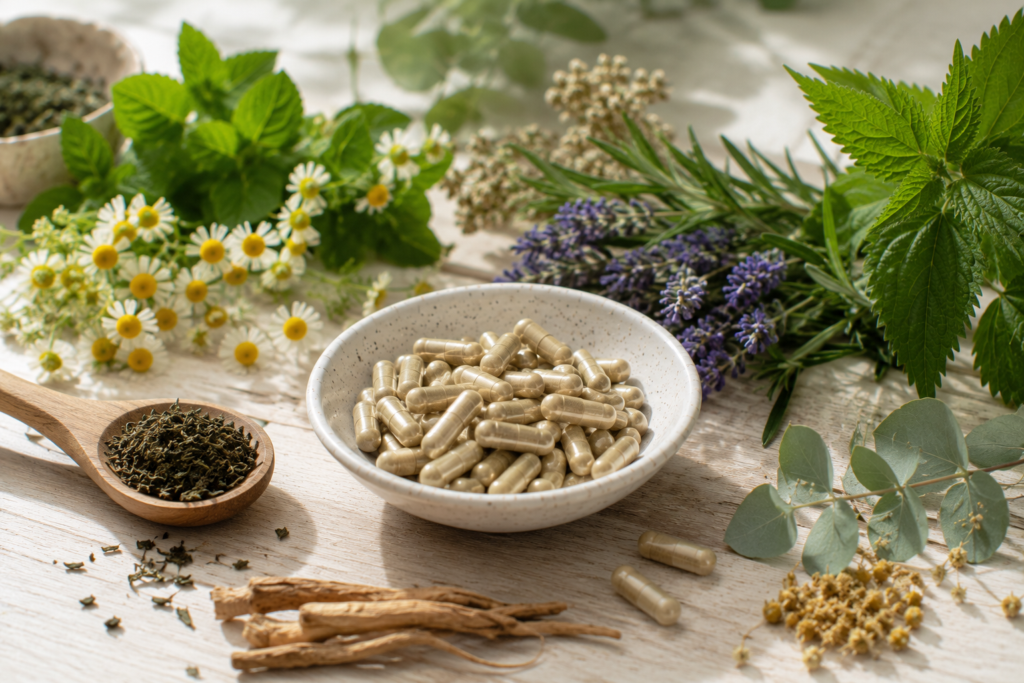
A strong herbal supplement begins long before ingredients reach an encapsulation line.
The identity, purity, potency and physical characteristics of each botanical ingredient shape nearly every stage of production. Ingredient quality can influence whether a formula blends uniformly, fits into the intended capsule, performs consistently during manufacturing and meets its finished-product specifications.
For brands entering herbal supplement capsule manufacturing, ingredient sourcing is not simply a purchasing decision. It is a product-development decision with implications for manufacturing efficiency, regulatory risk, consumer experience and brand reputation.
Ingredient quality begins with botanical identity
Herbal ingredients can be more complex to identify than isolated vitamins or minerals. A botanical specification may need to distinguish among:
- Botanical species
- Plant variety
- Plant part
- Country or region of origin
- Whole-herb powder or extract
- Extraction method
- Extract ratio
- Standardized constituents
- Carriers and processing aids
Two materials described by the same common name may not be equivalent. Different species may share a common name, and different parts of the same plant may have distinct chemical compositions.
For example, a formula designed around a root extract should not be manufactured with leaf material simply because both come from the same botanical species. The ingredient would no longer reflect the intended formula, research basis or label declaration.
FDA dietary supplement current good manufacturing practices require manufacturers to conduct at least one appropriate test or examination to verify the identity of each dietary ingredient, unless an approved exemption applies. Depending on the botanical and the level of processing, more than one method may be necessary.
Confirming identity at the beginning of production helps establish that the ingredient entering the formula is the ingredient the brand intends to sell.
Growing and processing conditions create natural variation
Herbal ingredients come from agricultural systems, not perfectly controlled chemical processes.
Their composition may vary based on:
- Soil conditions
- Climate
- Harvest timing
- Plant maturity
- Agricultural practices
- Storage after harvesting
- Drying methods
- Transportation conditions
- Extraction and processing techniques
This natural variation does not automatically indicate poor quality. It does mean brands and manufacturers need detailed specifications that define acceptable material.
A supplier may deliver two batches of the same botanical that differ in color, odor, density, moisture or constituent concentration. Without appropriate specifications, those differences can change the formula or interfere with manufacturing.
Ingredient quality therefore depends on consistency as much as it depends on origin. A commercially viable botanical ingredient must perform predictably from one production batch to the next.
Standardization affects formula strength
Many herbal ingredients are available as standardized extracts. These ingredients contain a defined concentration of one or more selected botanical constituents.
Standardization can help brands develop more precise formulas, but the percentage shown on a specification sheet does not tell the entire story.
Two extracts may use the same botanical while differing in:
- Standardized constituent concentration
- Extract ratio
- Extraction solvent
- Carrier system
- Analytical testing method
- Moisture content
- Particle size
- Bulk density
These differences affect how much ingredient the formula requires.
Suppose one extract contains 5 percent of a selected constituent and another contains 10 percent. A manufacturer may need twice as much of the first material to deliver the same standardized amount. That change can affect capsule capacity, serving size, cost and the balance of the complete formula.
Brands should define whether their product is based on total botanical weight, extract weight, a standardized constituent level or a combination of these measures. Otherwise, a supplier substitution may materially alter the product while leaving the familiar botanical name unchanged.
Purity affects product safety and brand risk
Herbal ingredients may carry contamination risks associated with cultivation, collection, processing and storage.
Depending on the ingredient and source, relevant specifications may include limits for:
- Heavy metals
- Pesticide residues
- Microorganisms
- Mycotoxins
- Residual solvents
- Foreign matter
- Undeclared ingredients
- Allergens
FDA regulations require dietary supplement manufacturers to establish specifications for identity, purity, strength and composition, as well as limits for contaminants that may adulterate the product.
A certificate of analysis can provide useful information, but it should not function as an automatic guarantee of ingredient quality. The value of a certificate depends on the supplier’s controls, the sampling method, the analytical method and the reliability of the underlying laboratory data.
Supplier qualification and appropriate verification testing help manufacturers determine whether incoming ingredients meet the specifications established for the product.
Poor-quality material can lead to rejected lots, manufacturing delays, product holds or recalls. It can also create reputational damage that extends far beyond the cost of the affected production run.
Ingredient strength affects label accuracy
Herbal supplement brands frequently develop products around specific ingredient quantities or standardized constituent levels.
If an ingredient does not meet its potency specification, the finished capsule may not deliver the amount declared on the label. Increasing the quantity used during manufacturing is not always a simple solution. It can change capsule volume, serving size, formula proportions and manufacturing cost.
FDA’s dietary supplement CGMP framework requires manufacturers to establish finished-product specifications designed to verify that the supplement contains what it is labeled to contain.
This creates a direct connection between raw-material quality and label integrity.
The manufacturer cannot produce a consistent finished product from ingredients that vary unpredictably in strength. Accurate formulation begins with reliable ingredient data.
Powder quality affects capsule capacity
Capsules have a fixed internal volume. The amount of material that fits inside depends not only on weight but also on density.
A dense botanical extract may fit comfortably into a selected capsule size. A lighter, more fibrous powder of the same weight may require substantially more space.
Ingredient density can affect:
- Capsule size
- Number of capsules per serving
- Excipient requirements
- Bottle count
- Packaging dimensions
- Consumer swallowing experience
- Manufacturing cost
A brand may design a formula around several hundred milligrams of multiple herbs only to discover that the blend will not fit into the intended capsule.
Higher-quality ingredients do not always have higher density. Quality in this context means the material is accurately characterized and performs consistently. Reliable bulk-density data allows the formulation team to make informed decisions before commercial production begins.
Brands can explore Somafina’s broader capsule manufacturing capabilities when evaluating capsule formats, formula requirements and production options.
Particle size affects blending and uniformity
Botanical powders can differ significantly in particle size and shape.
When ingredients have substantially different physical characteristics, they may separate during blending, transfer or encapsulation. Fine particles can settle into spaces between larger particles, while denser ingredients may move toward the bottom of the blend.
This segregation can create inconsistent capsules within the same batch.
One capsule may contain more of a concentrated extract, while another contains more of the formula’s lighter botanical powders. Even when the average batch composition appears correct, individual dosage units may vary.
Manufacturers can address these risks through:
- Ingredient screening
- Particle-size specifications
- Controlled blending sequences
- Geometric dilution
- Appropriate excipients
- Validated blending times
- In-process checks
- Finished-product testing
Ingredient quality supports this work by providing predictable particle characteristics. When particle size changes dramatically between lots, a previously successful manufacturing process may no longer deliver the same result.
Powder flow affects production efficiency
Encapsulation equipment depends on powder moving consistently through hoppers and into capsule bodies.
Some herbal powders flow easily. Others may be cohesive, sticky, fibrous, static-prone or sensitive to compression. Poor flow can lead to:
- Variable capsule weights
- Incomplete filling
- Equipment buildup
- Slower production speeds
- Increased material loss
- More frequent production interruptions
Moisture can make these problems worse. A botanical ingredient that absorbs water from the environment may clump or adhere to equipment.
Formulators may use flow agents, lubricants or other functional excipients to improve manufacturing performance. The need for these ingredients depends partly on the quality and physical behavior of the botanical material.
A brand pursuing a minimal-ingredient label may prefer to avoid excipients. However, eliminating a functional ingredient can be counterproductive when the resulting formula no longer fills consistently.
The better standard is not the shortest possible ingredient list. It is a formula in which every ingredient serves a clear purpose.
Moisture affects both ingredients and capsule shells
Moisture content is an important quality attribute for many herbal powders and extracts.
Excess moisture can affect:
- Powder flow
- Microbial stability
- Clumping
- Capsule-shell integrity
- Ingredient interactions
- Finished-product shelf life
Very dry or hygroscopic ingredients may also interact with the capsule shell by drawing moisture from it. This can contribute to brittleness or changes in capsule performance.
Manufacturers must evaluate the complete system, including the botanical blend, capsule-shell material, production environment and packaging.
Potential packaging decisions may include:
- Bottle material
- Closure type
- Induction seals
- Desiccants
- Light protection
- Storage statements
Packaging should support the actual stability requirements of the formula. It should not be selected solely for appearance or cost.
Extract carriers can change the finished formula
Botanical extracts may include carriers or processing aids used during extraction, drying or standardization.
These materials can affect:
- Ingredient density
- Powder flow
- Allergen considerations
- Label declarations
- Capsule volume
- Consumer positioning
A brand may believe it is purchasing a pure botanical extract when the commercial ingredient also contains maltodextrin, starch or another carrier.
That does not necessarily make the ingredient unsuitable. It does mean the complete composition must be understood before formulation and labeling.
Supplier documentation should clearly identify carriers and other relevant substances. The formulation team can then evaluate whether they fit the product’s technical requirements and brand standards.
Low-quality ingredients can increase total manufacturing costs
Lower-priced botanical material may initially appear to improve product margins. In practice, inconsistent or poorly documented ingredients can create costs throughout production.
Potential consequences include:
- Additional testing
- Rejected incoming lots
- Formula revisions
- Production delays
- Lower encapsulation speeds
- Increased material waste
- Failed finished-product specifications
- Packaging changes
- Product holds
- Customer complaints
The purchase price of an ingredient represents only one component of its true cost.
A more expensive ingredient that arrives with reliable documentation, consistent physical properties and predictable strength may reduce manufacturing friction and commercial risk.
Brands should evaluate ingredient value across the complete product lifecycle rather than choosing materials solely by cost per kilogram.
Supplier changes can change the product
Switching ingredient suppliers may appear to be a straightforward procurement decision. For herbal supplements, a supplier change can alter the formula’s performance even when the ingredient name remains the same.
A replacement ingredient may have a different:
- Origin
- Extract ratio
- Constituent concentration
- Carrier
- Particle size
- Density
- Moisture level
- Color
- Taste or odor
These differences may require new testing, formulation adjustments or manufacturing trials.
Brands should treat the supplier and ingredient specification as part of the product itself. Substitutions need technical review rather than automatic approval based on name and price.
Quality supports repeatable scale
A small development batch may tolerate minor ingredient variation. Commercial production amplifies those differences.
At larger scale, powders move through bigger blending and transfer systems. Flow, segregation and environmental exposure become more significant. A material that performs acceptably in a laboratory sample may create problems during a full production run.
Consistent ingredient quality helps manufacturers establish repeatable operating parameters for:
- Blending
- Encapsulation
- In-process testing
- Packaging
- Finished-product release
The objective is not simply to produce one acceptable batch. It is to manufacture the same product repeatedly as demand grows.
Somafina supports brands developing custom and private-label capsule products from formulation through packaging. Learn more about its private-label capsule manufacturing services. Somafina states that it brings 30 years of private-label supplement manufacturing experience to these projects.
Questions brands should ask about herbal ingredients
Before approving an ingredient for herbal supplement capsule manufacturing, brands should ask:
- Has the botanical species and plant part been confirmed?
- Is the material a whole-herb powder or an extract?
- What extraction process was used?
- Which constituents are standardized, and at what concentration?
- Does the ingredient contain carriers or processing aids?
- Which identity and purity tests have been completed?
- What contaminant limits apply?
- How consistent are potency, moisture and density across lots?
- Will the ingredient fit into the intended capsule and serving size?
- How will a supplier or specification change affect the formula?
Answering these questions early can prevent larger problems later in the development process.
Ingredient quality becomes finished-product quality
Ingredient quality affects far more than the information printed on a certificate of analysis. It determines how a botanical material behaves during formulation, encapsulation, testing, packaging and storage.
The strongest herbal supplement formulas connect four elements:
- A clearly defined product purpose
- Ingredients selected to support that purpose
- Specifications that define acceptable quality
- A manufacturing process capable of reproducing the product consistently
Herbal supplement capsule manufacturing cannot transform an inconsistent ingredient into a dependable finished product. Quality must enter the process with the raw material and remain controlled through every subsequent stage.
For supplement brands, that principle creates a useful standard: do not ask only whether an ingredient belongs in the formula. Ask whether its identity, composition and manufacturing behavior are strong enough to support the product the brand intends to build.